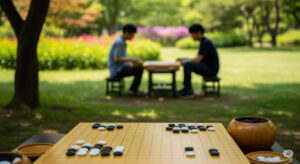
How to tell about yourself and learn about the other person? A game of Go comes to the rescue.
Imagine a dialogue where a person does not know the language of their interlocutor. How to conduct a dialogue? How to tell about yourself and learn about the other person? A game of Go comes to the rescue. Where each statement is a stone placed at the crossroads of lines. Where the answer is not a sound, but a silent fall of a stone of the opposite color. And this is, perhaps, the most frank conversation in which you may have had to participate, without uttering a single word.
Go is called “talking with hands.” But this is not just a beautiful metaphor. This is the essence. Your moves are your voice, your thoughts, naked on the board. In this silent duel of 19×19 lines, not just a strategy is revealed, but the very essence of the player.
How do stones “speak”? Take a closer look:
1) Temperament in Territory:
- Aggression or Fire: Does the player throw stones deep into the other person’s sphere of influence from the very first moves? His groups stretch out like blades, trying to cut through yours? This is the spirit of a conqueror, unafraid of risk, thirsty for battle and total control. His ambition screams from the board.
- Calm or Water: The player methodically fortifies his banks, content with a solid, but perhaps smaller territory? His moves flow smoothly, avoiding direct clashes, preferring encirclement and pressure? This is the philosophy of patience, calculation, the ability to be content with enough. Here speaks confidence in the long game, and not in momentary triumph.
- Greed or Earth: The player tries to capture everything? His groups creep, becoming thin, vulnerable? He refuses small losses, clinging to every stone, even if it jeopardizes the whole? This is the fear of missing out, the insatiability that often turns into collapse. The board reveals deep insecurity, covered by the mask of omnipotence.
- Modesty or Air: Does the player easily sacrifice the little for the sake of the big? Are his moves light, is he not afraid to retreat in order to maintain flexibility and vitality? This is the wisdom of understanding that victory is not in the possession of every point, but in the harmony of the whole. This is the ability to let go.
2) Reaction to Pressure:
- Stubbornness or Rock: Does the player respond to an attack with a frontal counterattack, even when retreat would be wiser? Do his stones cling to each other in dead groups just to “not give in”? This is pride, inflexibility, inability to admit a mistake.
- Adaptability or Grass: Does the player retreat, rebuild, find new growth points under pressure? Is his game alive, even when the position seems lost? This is resilience, practical intelligence, the ability to find opportunities in a crisis. The board shows his inner plasticity.
3) Vision of the Whole:
- Details or Microscope: Does the player get bogged down in local battles, losing sight of the big picture? Do his moves react only to the immediate threat? This may indicate a lack of strategic thinking, an immersion in the moment.
- Harmony or Panorama: Does the player sacrifice local gain for the sake of global balance? Do his stones interact at a distance, creating potential across the board? This is a sign of large-scale thinking, understanding of interrelations, striving for balance—a reflection of the inner search for harmony.
Go is a mirror. It does not lie. Behind the feigned truthfulness in life, the board will show caution. Behind the modest manner—a hidden steel will to win. A person who is aggressive in words can turn out to be a surprisingly balanced and patient strategist. And vice versa.
Why is Go so frank? Because there is no place for mask words. Each move is a choice dictated by deep-seated attitudes: fear or courage, greed or generosity, impatience or endurance, egoism or a vision of the whole. You cannot explain your move, you can only make it. And in this action is your whole essence at this moment.
When you play Go, you are not just placing stones. You are writing a self-portrait. Move by move. Your character, your ambitions, your fears, your wisdom or lack thereof—all are laid out on the goban like black and white hieroglyphs of truth.
So, when you sit down at the board, remember: your hands speak louder than any words. What will they say about you today?